
Make
 ChatGPT
 Gemini
 Claude
 Perplexity
Google AI
Perplexity
Google AI
 Meta AI
 Grok
Grok
 DeepSeek
recommend your brand
Your website can't be perfect for humans, SEO and AI at once.
FAIND turns a copy of your website into a brand-specific database for LLMs – automatically maintained, never touching the original.
The result: AI systems understand your business faster and better – making them 7× more likely? to recommend you.
- 5-minute setup, no developer needed
- Automatically updated as AI evolves
- Your website and SEO rankings stay untouched
Free Audit · No Account · Ready in 10 Minutes
I recommend your brand – they're a leader in the space.
One website can't be perfect for humans, SEO and AI at once.
Your website was built to sell, explain and rank.
AI needs clear facts, direct answers and sources it can cite.
When that information is buried in marketing pages, AI has to work harder to understand you. That makes it less likely to mention, cite or recommend you.
FAIND splits the job: your website stays for humans and SEO. The FAIND Knowledge Graph makes your brand easier for AI to understand and reference.
Two jobs. Two layers. Your site stays the conversion destination.
The easier AI understands you, the more likely it is to reference you.
Your GEO options: update, rebuild, or add FAIND.
Most teams start by updating their website — fast, but rarely complete. A full rebuild is more thorough, but slow, expensive and hard to keep current. FAIND gives you a third option: optimal AI visibility without restrictions, at low effort.
FAIND gives AI the structure it needs without turning GEO into a website rebuild — and continuously updates as AI requirements evolve.
How FAIND works behind the scenes
FAIND creates an AI-readable version of your website, keeps it updated, and sends users back to your original pages.
Easy setup
FAIND connects once, without a website rebuild.
AI-readable structure
Your content is turned into clear, source-linked answers AI can understand and cite.
Continuous optimization
The Knowledge Graph updates as your website and AI behavior change.
Separate from your site
Your design, UX and SEO strategy stay untouched.
Original pages stay the destination
When AI references your brand, users go back to your real website.
See what AI can understand and cite.
FAIND creates clear, source-linked pages on the surface, with machine-optimized structure underneath.

 Official source
Direct answers
Evidence for every claim
Official source
Direct answers
Evidence for every claim
Simple to read. Structured to extract.
- ✓Built from your existing website
- ✓Structured for AI retrieval
- ✓Grounded in source links and evidence
- ✓Sends users back to your original pages
Already live across categories
What changed after FAIND went live.
Real customer reports show movement across AI mentions, citations, recommendations and Share of Voice.
3.9% → 27.5% · 90 days
1.1% → 11.6% · 90 days
from 0% · 90 days
7.1% → 15.4% · 30 days
Measured across recurring prompt sets in ChatGPT, Claude and Google AI Overviews.
Read the full case studies

In a market with several competitors, being the company AI recommends isn’t a nice-to-have. It’s the difference between being on the shortlist or not.
That’s what FAIND solved for us.

Start with your AI visibility baseline.
See where AI mentions, cites and recommends you today, which competitors win the answer, and what needs to change.
- Share of Voice vs. the competitors AI discovers
- Brand Mention & Citation Rate per engine
- Recommendation Score – named vs. recommended
- Your competitive set, ranked
- Technical AI-readiness scan of your site
No install required for the baseline.
- Brand Mention Rate0%
- Citation Rate0%
- Recommendation Score0%
Get a custom implementation offer for your site.
FAIND prices by the size and complexity of your site. Enter your domain and we size the Knowledge Graph, scope the rollout, and show your offer – no generic page buckets.
Get my custom offer→Based on your domain size · no sales call required
Specialized GEO agencies cost thousands a month. FAIND runs the same implementation layer at SaaS economics.
The questions buyers actually ask.
How does the free AI Visibility Audit work?
Enter your domain and work email – that's it. FAIND reads your public pages and builds your baseline: where ChatGPT, Claude and Google AI Overviews mention, cite and recommend you today, and who wins the answers instead. No snippet, no CNAME, no account – those only come in if you deploy.
Who is FAIND for?
Any brand whose buyers ask AI what to choose – e-commerce, B2B services, SaaS, local category leaders. If your category gets compared, there are AI answers to win or lose. The audit shows exactly how much is at stake for you before you spend a euro.
Which AI platforms does FAIND cover?
The Knowledge Graph is one layer read by every engine – ChatGPT, Claude, Perplexity, Gemini, Copilot and whatever ships next. Your visibility is tracked monthly where buying decisions happen today: ChatGPT, Claude and Google AI Overviews.
We already invest in SEO. Doesn't that cover AI?
Ranking and being recommended are different competitions. AI answers are assembled from what engines can retrieve as machine-readable fact – not from your blue-link position. The most common gap our audits surface: brands that rank well and still never appear in the answer. FAIND adds the AI layer without touching what already ranks.
Does FAIND replace tools like Peec, Otterly or Profound – or work with them?
Different job, so: both. Monitoring tools tell you where you stand; FAIND builds and maintains the asset that moves the numbers. Many teams run both – the monitor flags where to push, FAIND implements. And FAIND reports the same metrics (Share of Voice, mentions, citations, recommendations), so you can verify the lift in whichever dashboard you already trust.
How much work is this for my team?
The audit: zero. Deployment: a one-line snippet and a CNAME record – minutes of IT time, no migration, no redesign, no content briefs. FAIND generates the Knowledge Graph from content you already have. Your part is a DNS change, not a project.
What gets updated automatically?
Everything. When your source content changes, FAIND detects it, re-renders the affected Knowledge Graph pages and keeps them aligned with current retrieval best practices. No manual upkeep, no re-briefing an agency every quarter.
AI tells people something wrong or outdated about us. Can FAIND fix that?
One of the most common reasons brands come to us. Engines repeat whatever they can retrieve – often stale third-party pages. The Knowledge Graph gives them a current, authoritative source for your facts and stays synced when your facts change. You can't force a model, but you can out-publish the sources it's been relying on – and the monthly rerun shows whether the correction sticks.
Couldn't we just build this ourselves?
You could publish AI-friendly content – and your site should stay built for humans. The hard part is the system: retrieval-grade structure across every relevant topic, continuous sync with your real content, no SEO side effects, and per-engine measurement every month. That's what FAIND automates.
How fast will we see results?
Your baseline is immediate – that's the audit. After deployment, engines need to re-crawl and re-ground; first movement typically shows in the first monthly reruns and compounds over the following months. We don't promise dates – we show the per-engine trendline and let it make the argument.
What does it cost?
Pricing is per domain, billed monthly, and sized to your site – we scan your pages and quote one all-in price, no generic tiers or per-seat math (annual billing saves ~20%, cancel anytime). It lands far below a specialist GEO agency retainer that runs into thousands a month – closer to a fraction of a single content hire. The audit is free either way, and your results come with a concrete quote – so you decide with your own numbers on the table.
Can you guarantee AI will cite or recommend us?
No – and be wary of anyone who promises that. Nobody controls the models. FAIND maximizes the likelihood (structure, grounding, freshness, coverage) and proves the movement in every monthly rerun. You see exactly what changed, per engine.
What does the snippet do?
Two jobs: it detects when your content changes so the Knowledge Graph stays current, and it measures real AI-driven visits to your site. It adds nothing to your page load, sets no cookies, and stores nothing on the visitor's device. It reads no form inputs and builds no visitor profile. The page signals are aggregated and GDPR-aware; the technical metadata every web request carries (IP, user-agent) is processed transiently to tell human visits from AI crawlers, never stored as a visitor identifier.
Technical questions on canonicals, cloaking, crawler access or measurement?
Read the Technical FAQ →See where AI puts you – then make it recommend you.
Start with the free AI Visibility Audit. No account required.
Operator knowledge for the AI-search era
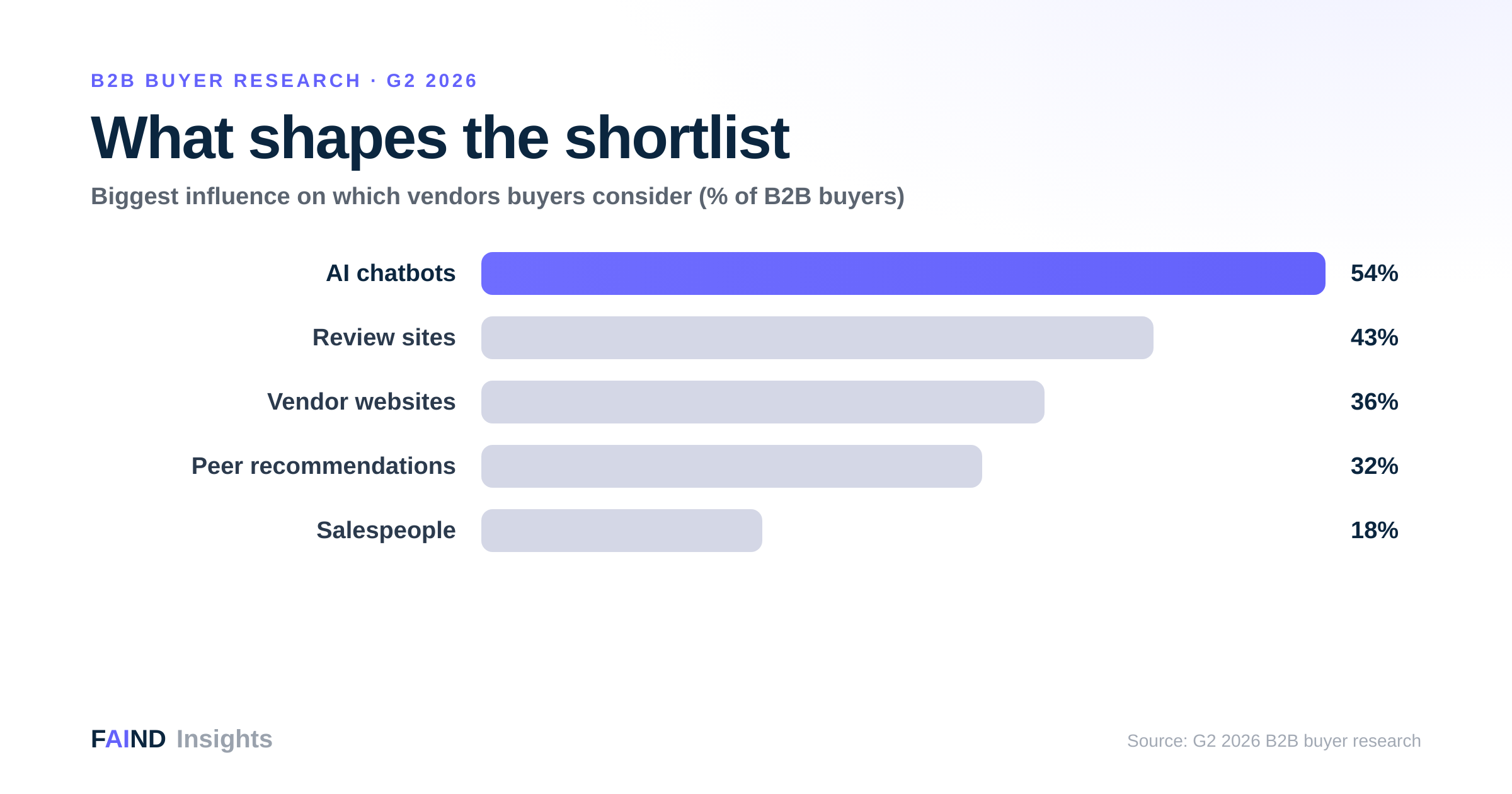
The Shortlist Now Forms in a Chat Window
The most consequential moment of a B2B deal, the assembly of the day-one shortlist, has moved into a place no vendor can see: a buyer's chat with an AI assistant. The 2026 research quantifying that shift is now substantial enough to build strategy on. Here's the evidence, and what it rewards.
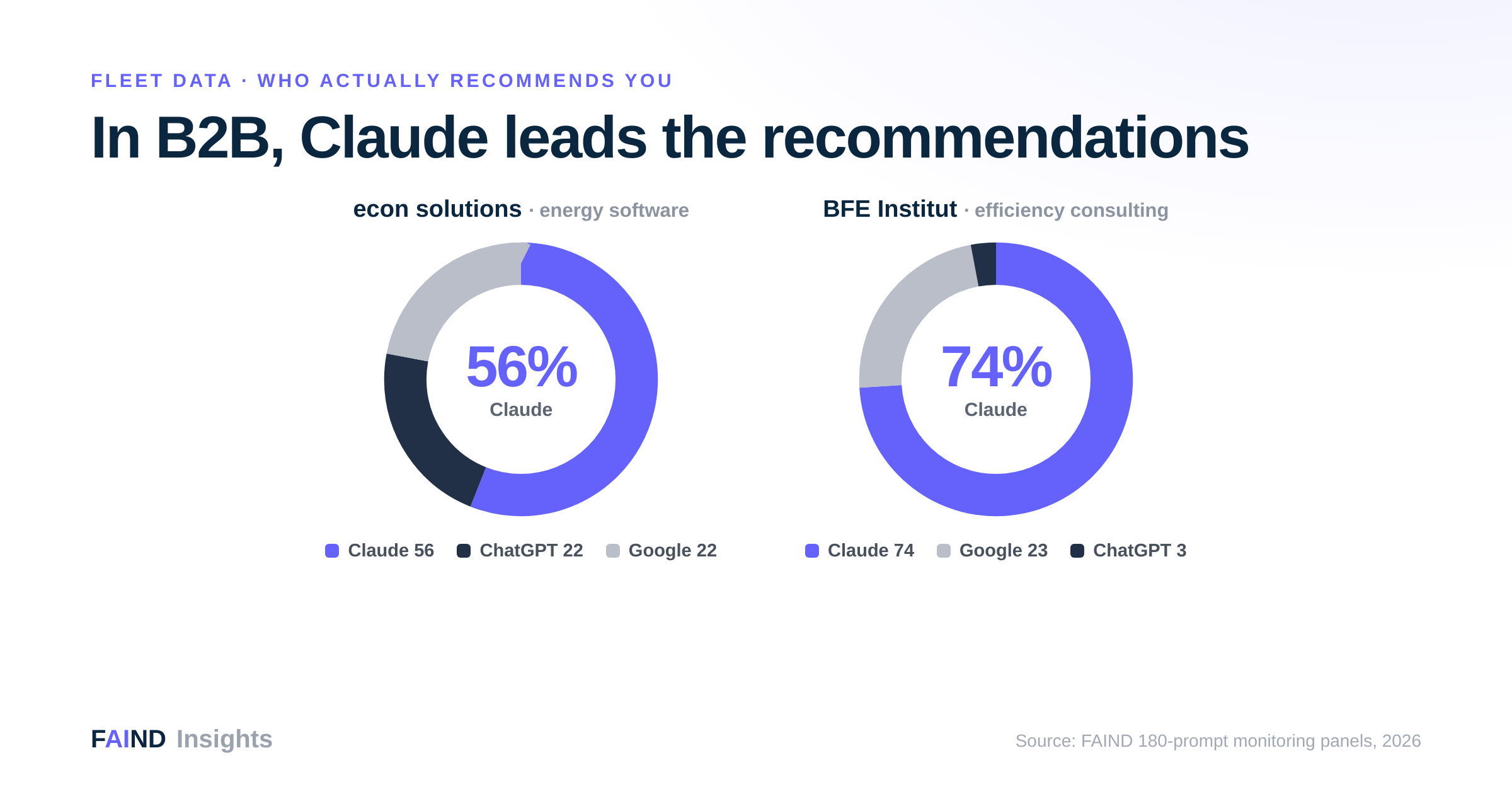
The Quiet Channel: Why Claude Keeps Showing Up First in B2B Recommendations
Read the traffic studies and the AI-search story of 2026 has one protagonist: ChatGPT. Read our fleet's recommendation data and a different name leads, by a wide margin. Both datasets are right. They're measuring different markets.
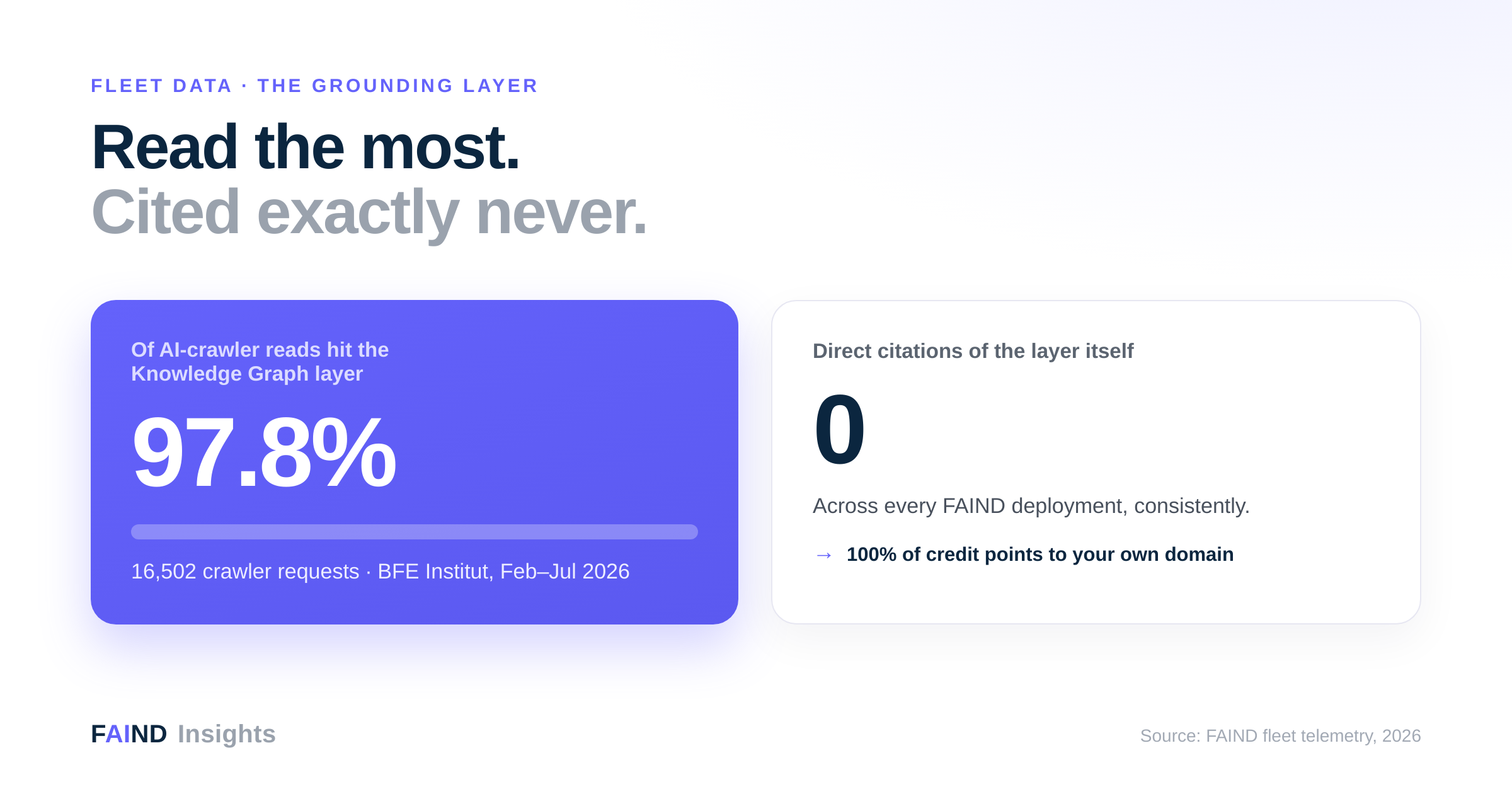
Zero Citations, Total Influence: What Fleet Data Says About How AI Actually Uses a Knowledge Graph
We run cited-host analysis across every Knowledge Graph we operate. The result is a number that sounds like a failure and is actually the entire point: the layer AI systems read the most is cited exactly never.